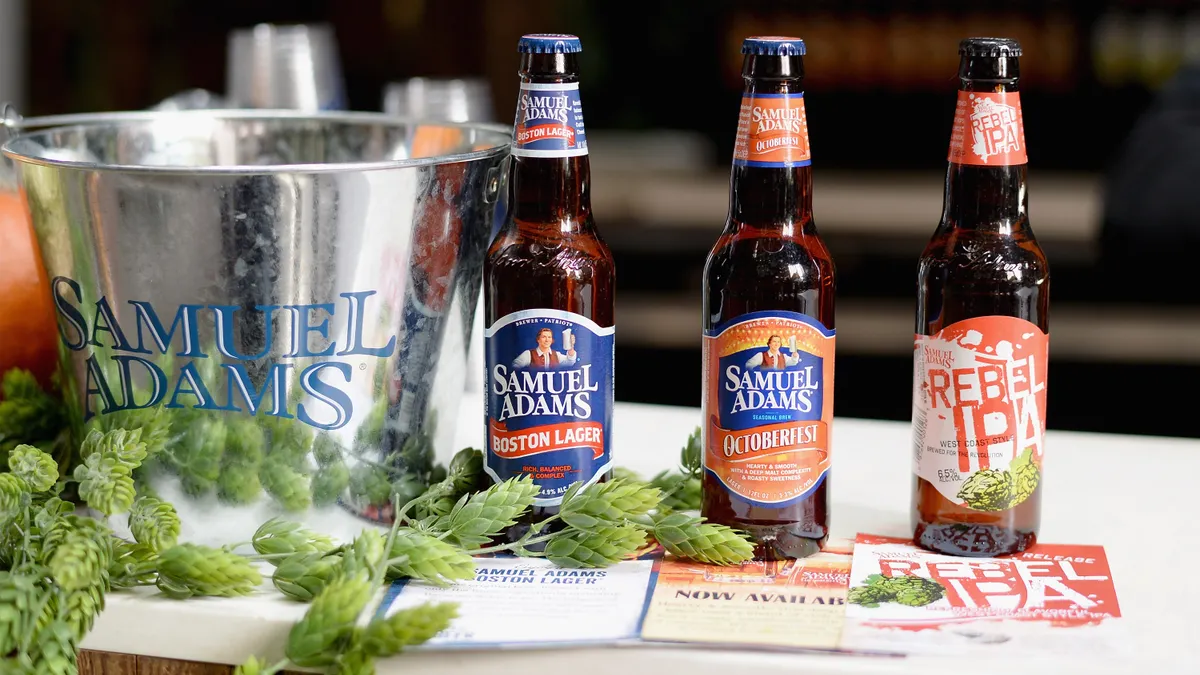
As alcohol consumption continues to hover at 54% of the adult U.S. population, the lowest it's been since at least 1939, brewers have had to get creative to reach consumers. From large brands such as Modelo, which is increasing its media investment by 18%, to smaller ones like Garage Beer, which has a new data center takedown campaign, brewers have looked for new ways to connect with consumers.
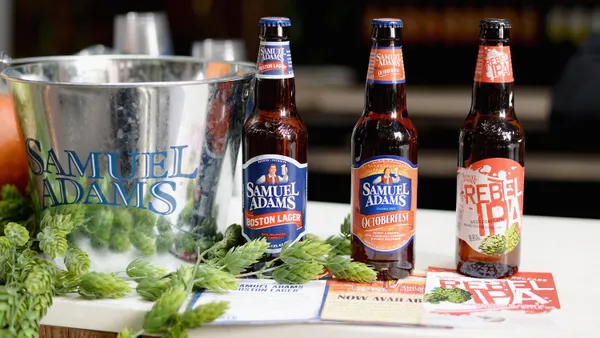
September saw two major players in the midsize beer space switch up their CMOs. Both Boston Beer and nonalcoholic brewer Athletic found new marketing heads as strategies shifted and budgets changed. The craft beer industry, which consists of smaller, independent brewers, seems split between growth and decline, with volume down in the first half of 2026 but outperforming the industry overall by 5.5 percentage points in 2025.
With Oktoberfest season in full swing, Marketing Dive has compiled some numbers that point to how beer brands outside the largest CPG players are navigating the evolving space.
$26.2 million
The Q2 total for Boston Beer's advertising, promotion and selling expenses.
Boston Beer, the company behind brands such as Truly and Dogfish Head, saw expenses related to advertising, promotion and selling increase 16.4% YoY in Q2. The company’s revenue fell 3.3% to $568.3 million during the same period, which in part was due to the slowdown of the hard seltzer market, where Truly is a major player.
The brewer announced in early September that Allison Stransky would be filling the vacant CMO position, effective Oct. 12. Stransky is joining the company from Samsung Electronics America where she served as CMO. The appointment comes as Boston Beer plans to reduce its planned incremental advertising range by $20 million, largely by cutting lower performing advertising, according to an earnings transcript.
“Some of the through lines on that are, most advertising doesn't work. Somewhere between 20% and 30% of CPG type advertising. So sophisticated, really quality advertising, 70% to 80% doesn't work, 20% to 30% works,” said Jim Koch, founder, chairman, president & CEO of Boston Beer during a presentation at Barclays 19th Annual Global Consumer Staples Conference.
Koch said the company has taken out all advertising support for brands until it can prove that creative improves incremental sales.
20.7%
The off-premise nonalcoholic beer market share held by Athletic Brewing
Athletic Brewing announced a 120% expected increase in national media spend in May. As the nonalcoholic beer segment continues to grow, the brewer has put an emphasis on sports and recently entered into a multiyear partnership with Metlife Stadium and its teams-in-residence, the New York Jets and The New York Giants.
In early September, the brewer, which describes itself as “America’s largest dedicated nonalcoholic brewer,” appointed Dan Kleinman as CMO, ending a monthslong search to fill the position after the departure of Andrew Katz, who was CMO for nearly half a decade.
As more Americans choose to abstain from drinking and health concerns take center stage, nonalcoholic beer has seen significant gains.. Nearly 90% of nonalcoholic beverages sold in the U.S. are beer. The growth has led to increased competition and the number of companies producing nonalcoholic beer jumped 134% between 2021 and 2025.
54%
The percentage of craft brewers who reported volume growth in H1 of 2026
In the first half of 2026, 43% of craft brewers reported volume declines, which fell to 40% when looking at operations producing over 10,000 barrels, according to data from the Brewers Association. Not only were these larger breweries less likely to report declines, 59% said they saw growth in the first half of the year, 5 percentage points higher than the overall average.
Craft beer consumers are drinking more craft beer, per the association. Among craft drinkers, 85% consume the drink monthly, up 10% YoY. It is also the highest level of consumption since 2020, per data from the organization and Harris Poll.
However, the craft beer industry is facing challenges. Volume is down 4% YoY. The number of breweries declined 1.8% between June 2025 and June 2026. Regional breweries and microbreweries declined by 3% each.