During their first unified NewFronts presentation, Walmart and Vizio pitched the scale and strength of a full-service offering that connects content to commerce within a single ecosystem. But the retail giant and its connected TV subsidiary weren’t the only ones to roll out innovations around targeting, measurement and commerce at the IAB’s annual showcase. Together, these developments paint a picture of where CTV is headed as it continues to gain ground with viewers and narrows in on unique capabilities around measurement, performance and AI.
“I cannot remember a more dynamic time in the industry. Every facet of the business is being reinvented and the days of impressions as a proxy for results are fading. Streaming and CTV are now performance-driven channels, directly accountable for business outcomes,” IAB CEO David Cohen said in a statement. “AI is now embedded across the entire value chain, reshaping how content is created, how media is bought and sold, and how performance is measured.”
Advertising divisions at CTV equipment manufacturers, media conglomerates and streaming platforms utilized their NewFronts presentations to make their cases to brands and agencies around why they represent the best options for reaching ad-wary, cord-cutting consumers in a fragmented media landscape. As The Trade Desk faces pushback from both Publicis and Omnicom, Amazon’s demand-side platform showed up in several presentations that positioned the company’s offering as a go-to pick for marketers.
The Amazon front
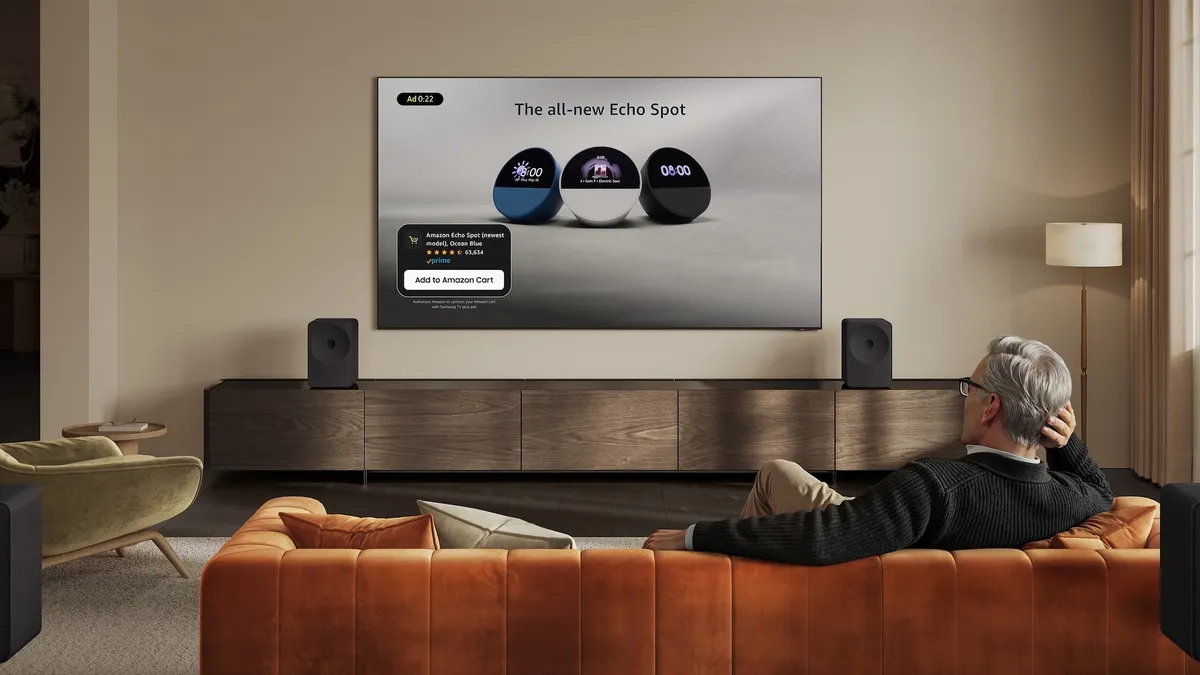
Samsung on Tuesday made a series of announcements that position the TV maker as a full-funnel performance platform. Among them was the most significant tie-up with Amazon Ads announced at the NewFronts. The electronics company will bring Amazon’s Interactive Video Ad technology to Samsung TV Plus, making it the first external CTV device partner to offer this capability. The integration will launch in July and allows viewers to take action with their remotes, either via “Add to Cart” functionality for brands that sell via Amazon or actions like “Send to Phone” and “Sign Up Today” for nonendemic brands.
“We're continuing to deliver the same seamless buying experience that advertisers are used to and accustomed to, powered by Amazon's authenticated graph, which provides true deterministic reach to over 90% of U.S. households. So brands can also tap into Amazon's trillions of browsing, streaming and shopping signals to gain robust measurement and insights all the way across the funnel,” said Kelly MacLean, vice president of engineering, science and product for Amazon DSP, during Samsung’s presentation.
Samsung will also open advertiser access to its Samsung TV Plus inventory via Amazon DSP. Amazon has worked to grow the ad inventory available via its DSP through deals with Netflix, Roku, Spotify and others. In kind, Tubi announced during its NewFronts presentation that the Fox streamer is expanding its partnership with Amazon DSP.
Tubi represents one of the largest publishers by reach on the DSP, with 10% of its audience unique and incremental across Amazon’s open-internet streaming TV supply, per details shared by the streamer. Advertisers now have first-look access of Tubi’s audience, 85% of which can be matched via Amazon Ads and its authenticated graph.
“Advertisers are seeing a 42% increase in unique audience reach, a three-fold increase in ROAS and a 27% reduction in frequency per user,” MacLean said of Amazon’s ad offering during Tubi’s presentation. “Equally importantly, we can see which publishers are bringing you genuinely new audiences, versus just recycling the same viewers you’re already reaching.”
Amazon will also make its own Prime Video ad inventory available to Comcast Advertising’s small-to-medium sized customers. These media buys will be executed by Amazon DSP, allowing Comcast Advertising to customize and localize ad messages, but with the scale and simplicity of a single national buy.
AI-powered solutions
Beyond its Amazon tie-up, Comcast focused its NewFronts presentation on Outcomes+, a new solution that offers targeting and attribution across company’s premium TV and streaming inventory. Key to Outcomes+ are a handful of AI-powered tools powered by Comcast’s first-party data troves.
Comcast’s AI tools include a proposal assistant that helps advertisers optimize reach, efficiency and precision when creating campaign schedules; an audience discovery engine called Lens that helps find households with light or no exposure to national TV campaigns; and Blockgraph On Demand, which helps brands match their first-party data with that of Comcast.
The new AI tools helped automaker Mini USA optimize its campaign to sequence addressable messaging between national, regional and local automotive tiers. The campaign drove a 300% increase in brand favorability and a 200% increase in brand recommendation intent, with participating dealers seeing a conversion lift of 35% for new and used vehicles.
Samsung also pitched a pair of AI-powered tools that help advertisers with contextual targeting and audience collectives. The former helps brand appear in the right place at the right time through continuous interpretation of on-screen action, while the latter leverages proprietary insights across devices to identify consumers most likely to engage, convert or respond.
“If Samsung TV Plus is the foundation and AI is the engine, performance is the impact,” said Sang Kim, executive vice president and head of the North America service business at Samsung Electronics, in a statement. “When TV becomes interactive, performance follows. Samsung is turning attention into action by bringing intelligence, interactivity, and measurement together on the biggest screen in the home.”
Measuring outcomes
The need to target ad buys, often with AI-powered tools, is only half of the problem marketers face in a fragmented TV landscape. Accurate measurement remains a problem, especially as marketers increasingly favor measuring outcomes rather than using viewership as a proxy for results.
“With AI driven precision and premium quality data, Outcomes+ empowers advertisers to find the right audiences and measure outcomes across the entire funnel — because real impact happens throughout the journey, not only at the last click,” said Dawn Lee Williamson, chief revenue officer for media solutions at Comcast Advertising, in a statement.
The Outcomes+ offering unites Comcast’s deterministic TV-viewing data with insights from several partners, giving advertisers a better view of their campaigns at all stages of the sales funnel. Comcast announced new and expanded partnership with Mastercard, Sojern, Clarivoy, Disqo, Dynata, Fandango and Polk from S&P Global Mobility that focus on different brand verticals, including travel and automotive.
Comcast helped a major auto brand drive higher conversions by combining Polk Signals transaction data with its own ad exposure data and found that dealers participating in a coordinated national, regional and local advertising program saw a 25% increase in vehicle purchase rates.
Partnerships are key to Tubi’s measurement offering, as well. A deal with InMarket allows restaurant, retail and CPG brands to directly measure sales performance, while an expanded partnership with Kochava helps Tubi’s studio advertisers measure ticket sales and conversion activity through Fandango. Finer measurement could help Tubi — the second largest free, ad-based video-on-demand platform behind YouTube — attract advertisers.
“With massive scale, original and exclusive programming on the pulse of culture, and industry-leading investments in ad tech, precision and measurement, we are helping advertisers achieve greater reach, relevance and efficiency at a time when they need it most,” Tubi CEO Anjali Sud said in a statement.
Peter Adams contributed additional reporting to this story.