

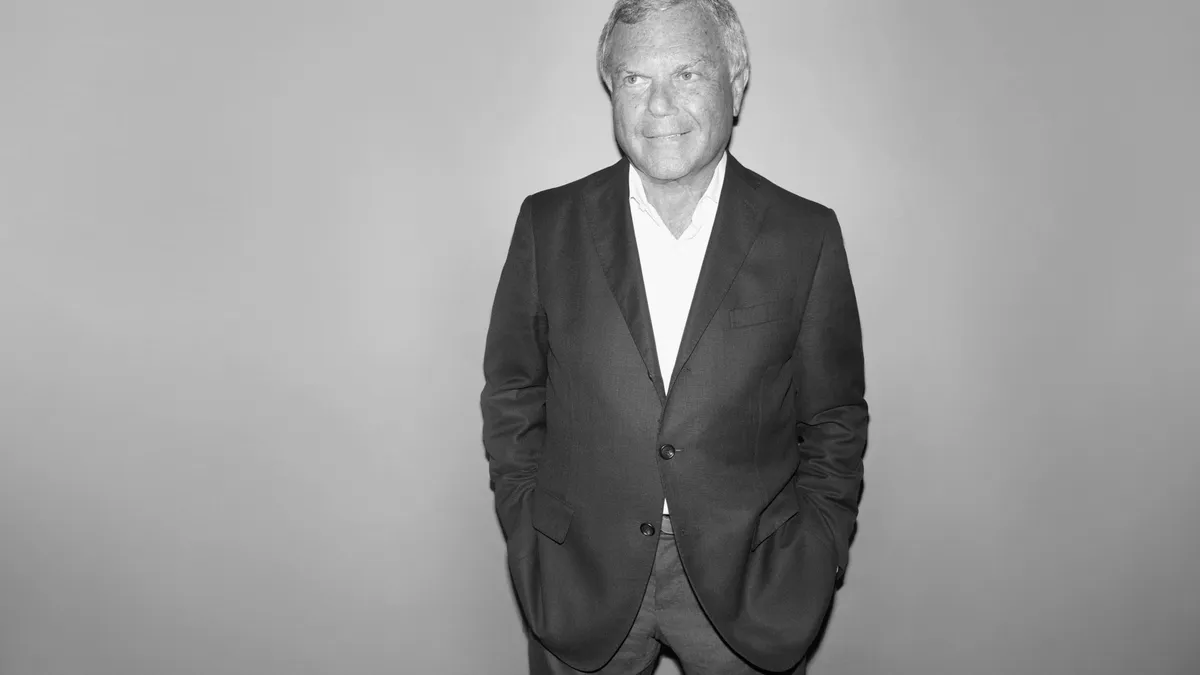
Martin Sorrell has a lot on his mind: artificial intelligence, media transparency, the Iran War and tariffs, to name a few points of friction. The founder and executive chairman of S4 Capital, which owns Monks, sees an agency sector that is grappling with largely flat revenues but remains complacent in the face of gathering storm clouds, setting itself up for a rude awakening in the future.
“It can’t carry on as it is,” Sorrell said in an hour-long sit-down interview with Marketing Dive last week. “Or rather, it isn’t carrying on as it is, because it’s basically flat as a pancake.”
The executive, who helped shape the modern ad-holding group model by building out WPP through aggressive M&A, also questioned the moves of rivals, including Publicis Groupe’s recent spat with The Trade Desk and Omnicom’s handling of its acquisition of Interpublic Group.
“To my mind, that’s a defensive merger,” Sorrell said of the Omnicom-IPG deal. “It’s very similar, to my mind, to Paramount and [Warner Bros. Discovery] in that one side's gonna not survive.”
Sorrell’s breakdown of the myriad challenges facing agencies in 2026 comes as his own network has struggled with growth. S4, which positions itself as a digital-first challenger to holding companies with roots in traditional media, saw like-for-like net revenue slide 8.5% in 2025. However, the company’s revised results were better than expected while its net debt ultimately came in lower than consensus estimates.
Changing growth dynamics
One of agencies’ chief problems is that ad spending growth is no longer directly tied to other measures of economic health, such as GDP. Ad-spending forecasts have been relatively resilient despite the impact of tariffs, while the stock market has avoided a worst-case scenario, but agency earnings are a mixed bag.
“The traditional correlation was if clients did well, agencies did well. There was, I think, a very tight correlation between corporate profitability and ad spend,” said Sorrell. “You would think that ad spend would increase. [That’s] not happening.”
Sorrell was also wary of relying too much on assessing other ad-holding companies’ earnings data, believing it’s not “highly dependable” since different networks have different ways of reporting revenue, an issue that has been raised by other leaders in the space.
Another disruption for agencies is that some categories, namely technology, are shifting more of their resources from operational expenditures — an area that includes marketing — to capital expenditures to the tune of over $600 billion as they race to develop AI products. Nearly half of S4’s client roster is in tech, creating a difficult situation for the Monks owner.
Lastly, the Iran war is significantly roiling an already teetering economy beset by on-again, off-again tariffs and stubborn inflation. As the Middle East conflict stretches on with no clear end in sight, marketers are unlikely to make big decisions.
“There’s just a general caution,” said Sorrell. “I’ve got to say, I think getting up every morning and having to deal with the implications of all this uncertainty is not pleasant for marketers.”
Rising tensions
As agencies navigate these headwinds, some are trying to more aggressively assert their economic power. That’s at least how Sorrell views Publicis last week recommending clients to not work with The Trade Desk after saying the demand-side platform failed a third-party audit, claims the ad-tech firm’s leadership has contested. The dustup has raised broader questions around media transparency, with Sorrell believing agencies will struggle to stand up to deeper scrutiny into their practices.
“I don’t think the agencies will be able to withstand a demand from the client to know what the price is and what the margin is. I mean, The Trade Desk-Publicis dispute is effectively that,” said Sorrell, who suggested Publicis may have shot itself in the foot with the maneuver.
“If I was the client, I would say I have audit rights — which most of the big sophisticated clients do have — and I want to audit what you’re doing,” he added.
Principal-based media buying, when agencies both buy and resell media to their clients, is another area where agencies are again in the hot seat following a high-profile lawsuit against WPP and new research from the Association of National Advertisers underscoring marketers’ growing uncertainty about the practice, which is increasingly common. Sorrell wasn’t opposed to the concept in principle, noting that agencies often broker complex deals with publishers that factor in multiple clients and can receive better pricing for their efforts.
“I think there is an argument that it should be kept by the agency,” said Sorrell of discounts offered by publishers. “The question is whether procurement at clients will accept that, whether that will prevent them from saying: ‘That's ours and not yours.’”
“I think the general point is everybody is looking for transparency,” Sorrell added.
Beyond tensions between advertising companies, Sorrell also frequently returned to the turbulence inside of agencies, specifically Omnicom following its $13 billion-plus takeover of IPG. The executive pointed to Omnicom’s reportedly chilly handling of some layoffs, including alleged mass firings where leaders kept their video cameras turned off during the meeting, and the organization's plans to enact $1 billion in labor cost reductions, a figure higher than previous targets.
“I’m not saying that any of us are softies, but there's a brutality which is quite shattering,” said Sorrell.
AI’s threat and opportunity
Agency contraction could intensify as AI is adopted at scale. Visualization, copywriting, personalization and media planning and buying are some of the ripest functions to be taken over by AI, Sorrell predicts.
Meanwhile, agencies need to contend with stiffer competition from hyperscalers — the Googles and Amazons of the world — that are investing heavily in one-stop-shop AI tools for advertisers. Those offerings are frequently targeted at small- and mid-sized marketers, but could eventually be positioned for larger clients that make up agencies’ bread and butter.
Agencies aren’t investing sufficiently in AI technology to keep up, per Sorrell, which could lead to a massive amount of compression. Half of agencies’ proprietary AI platforms will either shutter or become obsolete by 2029 as enterprise organizations opt for platforms developed by hyperscalers, according to Gartner forecasts.
Not everything is doom-and-gloom when it comes to AI in Sorrell’s mind. The technology, which he says he’s optimistic about, could bolster efficiency and streamline organizations to get rid of silos. S4 in 2024 launched Monks.Flow, an AI-powered managed service offering aimed at assisting clients with adapting to the AI era. The problem is many brands are still stodgy in their thinking when it comes to AI, including through legal and procedural resistance, Sorrell explained.
“It’s extraordinary but clients don’t move fast enough. So it’s not about technology, it’s about change management and it’s also about simplifying workflow,” said Sorrell. “I mean, Monks.Flow is really about that.”