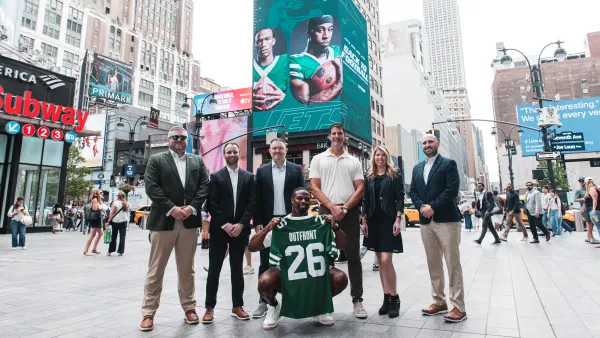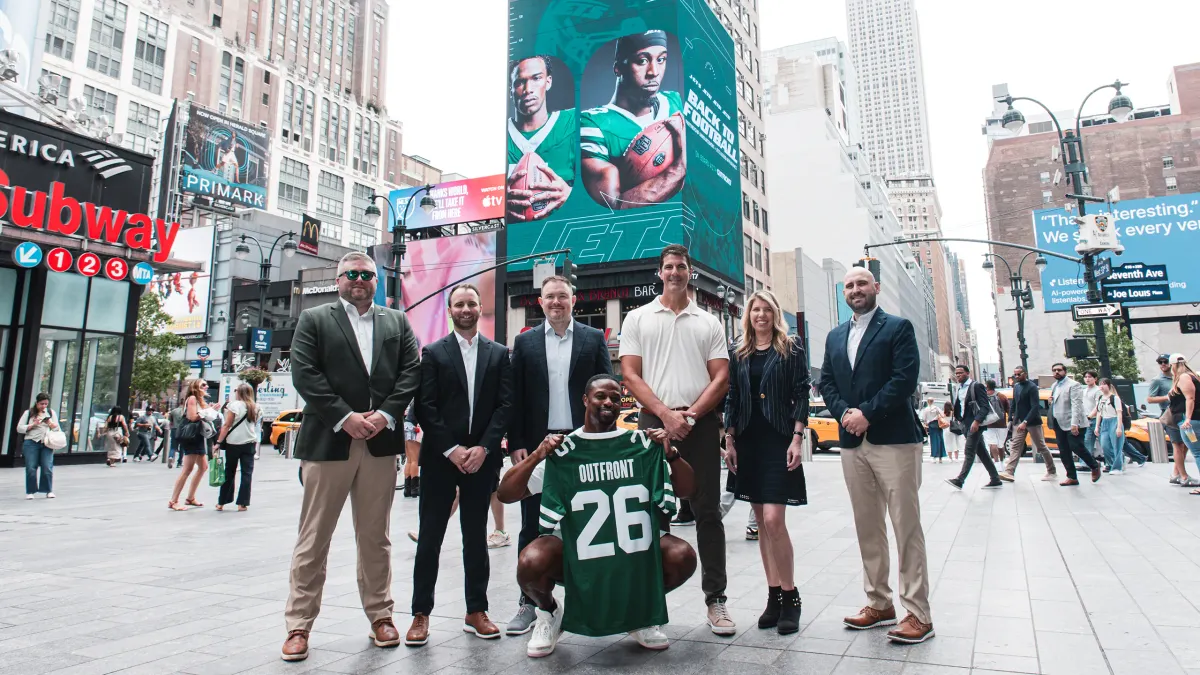
To capture some of the widespread, unbridled enthusiasm for football, the New York Jets organization this season is working with corporate partners to reach fans via a mix of out-of-home and experiential activations in an approach referred to as IRL media by Jets partner Outfront.
In the past, the Jets’ offerings for brand partners and corporate sponsors have included broadcast, digital, radio and some in-suite experiences. IRL media provides another lever to connect brands with fans. The offering extends the reach of OOH to reflect the ways in which consumers might interact with brands in the real world and enhances storytelling capabilities by tying these activations together.
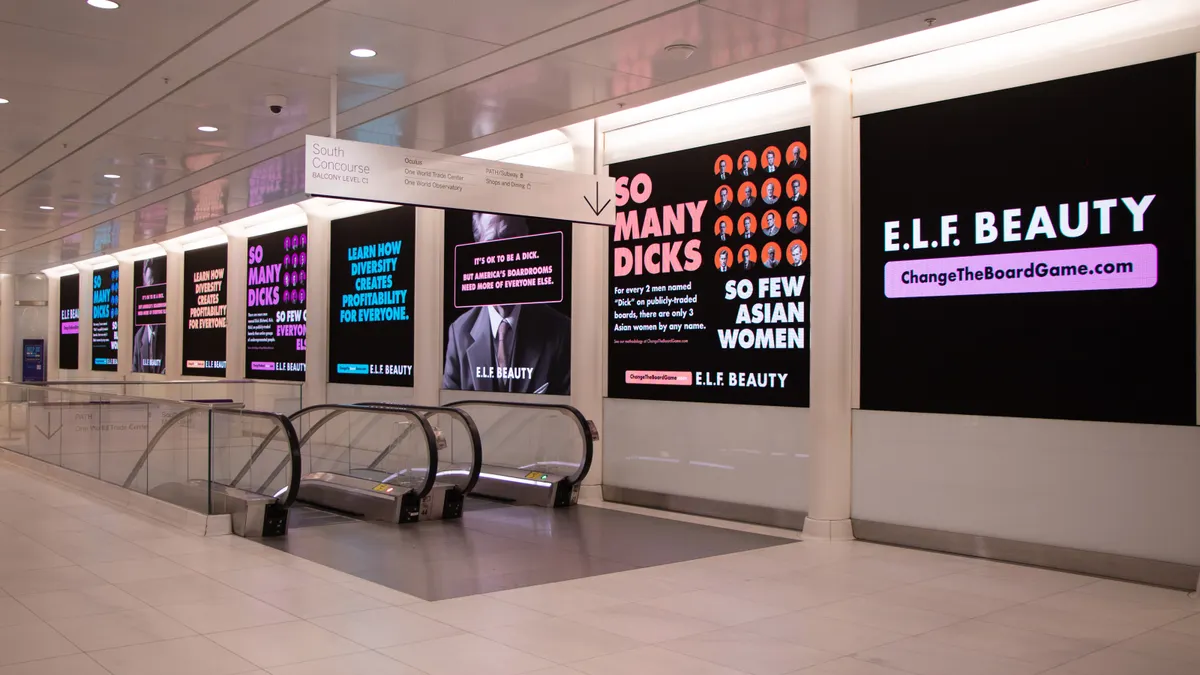
“It’s billboards, it’s bus shelters, it’s digital signage, it’s building wraps and it’s so much more,” said Stacy Minero, chief marketing and experience officer at Outfront. “It’s also brand pop-ups, interactive brand experiences. We’re thinking about this in a much more expansive way than just outdoor.”
OOH renaissance
Fueled by the growing trend of consumers trying to separate themselves from their phones in favor of real-world experiences, the OOH sector is experiencing a renaissance of sorts.
Global OOH ad spending is projected to hit $56.4 billion this year, up 4% over 2025, according to the World Out Of Home Organization. Spending in 2025, meanwhile, was 15% higher than 2024. In the U.S., marketers spent $2.12 billion on OOH in Q1 2026, according to the Out of Home Advertising Association of America.
Moreover, 73% of consumers view digital OOH advertising more favorably than television, social media, online, audio or print, according to 2024 OAAA and Harris Poll research. Separately, a 2025 survey conducted by Harris Poll and Quad found 76% of consumers felt interacting with a brand in person deepens their connection to it. Additionally, 84% of Gen Z and millennial consumers value brands that can blend digital and IRL experiences.
For the Jets and its partners, adding a physical layer means extending the fan experience beyond the eight home games scheduled at MetLife Stadium this year. By leveraging its properties across the New York metropolitan area, Outfront gives the team and partners the opportunity to reach fans with relevant, specific content throughout their day.
Outfront’s network includes live boards on train station platforms and inside subway stations as well as roadside billboards.
“[They] can tap into that whole suite of inventory to stitch their story together in a compelling way,” Minero said.
Possible use cases include creating a countdown clock to a certain game or using real-time data and news about the team or playing conditions. Marketers can also layer in interactivity, such as placing a QR code in certain ads to unlock offers and promotions.
Minero characterized the Jets partnership as “a new way of working and collaborating” that goes beyond the activations Outfront has had with other sporting events and teams, including the FIFA World Cup and Formula E racing contest. Instead, there are more storytelling opportunities because of the way different media can be used across a fan's journey. There's also more collaboration with the team's marketing partners, with a focus on comprehensive campaigns instead of one-off ads.
“This is a new blueprint for sure,” Minero said.
One challenge marketers may face with IRL media is that the results are more difficult to quantify than the clicks and other interactions that happen in the digital world. Outfront is working with partners to develop a measurement ecosystem that can better reflect the outcomes delivered through such campaigns.
“It’s not about just launching campaigns; it’s about creating campaigns that are meaningful and memorable, that are driving relevance and impact,” Minero said.
Looking ahead, Minero envisions taking IRL media beyond sports. The ability to help a brand connect with a target audience can extend to nearly anywhere that group may be gathering.
“One opportunity we’re taking to market is called Conference Connect, where people can invest in IRL media surrounding a B2B conference,” she said, noting the size of events like Dreamforce and Re:Invent. “Those have gotten so big, they are taking over the [host] city, and they keep growing.”