Aerie is doubling down on a commitment to using real, unfiltered people in its marketing through a tie-up with actor Pamela Anderson. The American Eagle Outfitters brand’s partnership extends an “100% Aerie Real” campaign that pushes back against artificial intelligence-generated content.
The latest iteration of “100% Aerie Real” launches Thursday with an ad starring Anderson that will air across paid social and connected TV. The campaign will be amplified with creator content beginning in April. Aerie launched “100% Aerie Real” last October with social media ads sharing a pledge to never use AI-generated bodies or people in the brand’s marketing.
The concept is a natural next step for Aerie, which in 2014 promised to stop retouching people as part of a “#AerieReal” campaign. As AI use continues to progress at a rapid pace, the apparel and intimates brand is prioritizing transparency to preserve its brand ethos and build loyalty with new and existing customers, explained CMO Stacey McCormick.
“While others continue to chase perfection or digitally enhance through AI, we are going to stand for something fundamentally different, which is [being] real,” said McCormick. “That clarity has proven a stronger emotional connection with the customer.”
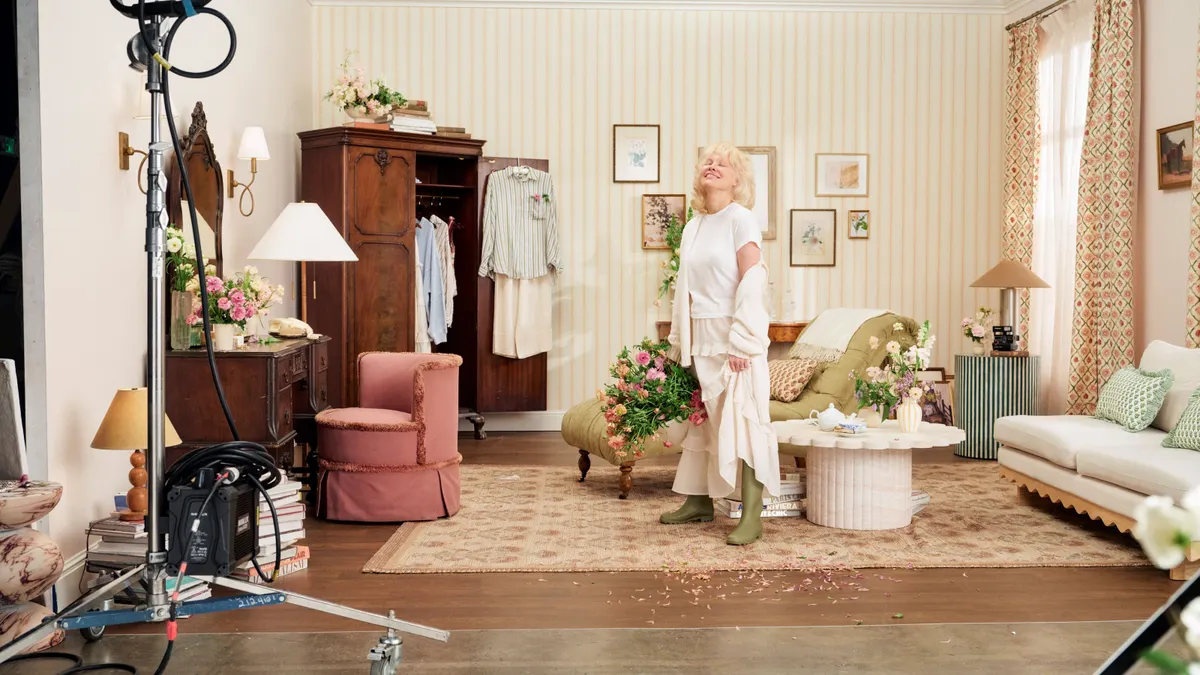
Key to the campaign is a 60-second spot, also running as a 30-second cutdown, that opens with Anderson prompting an AI bot to populate models on screen. Anderson struggles to refine her vision — requesting that the models look happy, more natural and less lifeless — and ultimately demands to “make them feel real” before the artificial scene dissolves, revealing a cozy, authentic Aerie set full of energy. As the spot ends, Anderson says directly to the camera, “You can’t prompt this.”
The spot was directed by Gemma Warren with photography by Adrian Martin and social direction by Madeline Kate Kann. Agency Shadow handled creative, production and casting.
The decision to team with Anderson was an easy one, McCormick explained: The former “Playboy” model famously reclaimed her narrative following decades of exploitation, and has embraced her natural beauty by opting to go makeup-free for public outings.
“It doesn’t get more real than Pamela — she embodies real and what it means to reclaim yourself,” McCormick said. “We know the influence she has, our audience really responds to her and we know she transcends age within audiences.”
The value of being real
The latest extension of Aerie’s campaign will include placements across paid social, YouTube and streaming platforms, including Amazon Prime Video, Netflix, Hulu, Disney and more. Additional content includes behind-the-scenes footage of Anderson. Beginning in April, a handful of creators will also share content featuring their own perspective on the brand’s approach to AI to reinforce the campaign’s message.
Along with Aerie’s own pledge against using AI in its marketing, the brand requires the creators it works with to commit to the same promise. There are some use cases for AI within Aerie’s business operations, including for functions related to its supply chain and analytics, McCormick explained, but setting a firm boundary around the tech is one way the brand is upholding core values like trust and integrity.
“We’re not doing it for the sake of fighting AI — to us, it’s our version of accepting AI,” McCormick said. “Our version is basically saying that the world is changing so quickly, and in an industry where everything can be generated, real becomes special and real becomes rare, and what’s rare becomes more powerful and more unique in the marketplace.”
“100% Aerie Real” arrives on the heels of a successful 2025 for Aerie, which reported a 9% year-over-year increase in comparable sales for the full year. In Q4, the brand posted a 23% comparable sales increase and strong performance across categories, including apparel, activewear and intimates, the latter of which has recently received renewed focus.
“Competitor-wise, you don’t really have all three of those [categories] playing together, so we really have a competitive edge,” McCormick said.
McCormick attributes the win in part to parent company American Eagle Outfitters’ increased advertising spending, which has allowed for higher-profile bets like sister brand American Eagle’s recent partnerships with Sydney Sweeney and Travis Kelce. The executive also credits the success to a decision by Aerie in the fall to expand its target audience from those aged 18-35 to consumers up to age 45, a move that helped it exit Q4 with record brand awareness and a double-digit increase in customer acquisition.
“We wanted to get more people into the brand — there was really no reason to only target up to a 35 year old, if you think about the demographics themselves and knowing how our product can be worn by many,” McCormick said. “We went into Q4 with about 50-plus, 57% to 58% brand awareness. We came out of Q4 up 21% in brand awareness, and as we go into February, we’re seeing that brand awareness grow even more.”
Other brands beyond Aerie have recently launched marketing campaigns that are designed to reject the rapid increase in AI-generated content. Earlier this month, better-for-you soda brand Zevia debuted a campaign meant to draw a connection between the AI craze and the artificial ingredients used by its rivals. In January, Crocs launched a brand platform designed to combat what the footwear brand calls algorithmic sameness.
“I hope we see more and more people stand up,” McCormick said.
For Aerie, its latest move is about continuing to fortify the principles of the “#AerieReal” promise made over a decade ago, not only for existing customers, but also for new consumer groups like Gen Alpha who have growing familiarity with the brand. Most importantly, the push is less about the marketing and more about the message behind it.
“It’s not a fluke, it’s not a campaign, it’s not a trend — this is a true commitment,” McCormick said. “We hold value in remaining unique in that even if everyone else around us is all AI, we think value is redefining what AI is in the fashion space.”